Migration plan for Shop Vapour
Prepared by Trisdel · 2026-09-29
Migration plan for Shop Vapour
Built from what is publicly visible at shopvapour.co.uk.
You didn’t ask for this. We built it because most stores moving off Shopify right now are losing search traffic on the way out, and we’d rather show you than tell you.
Nothing here needs a call. If you never reply, the acceptance test in §5 is still worth handing to whoever does move you.
 12
12Your storefront as it loads today, 2026-09-29. This is what we mean when we say the design doesn’t change.
- 6,212 products and 646 categories live behind this menu. Every one has an address a migration can break.
- Layout, branding and banners rebuilt exactly as they are, at the same addresses.
Why you’re getting this
Shopify started removing vape and nicotine sellers in the summer of 2026. Merchant notices went out from 24 June with a removal deadline of 7–8 July, and by mid-July the policy was confirmed as global. UK merchants included, MHRA-notified products included. UK law has not changed. Selling vape online here is still legal. This is a platform deciding what it will host.
Shop Vapour is still trading, and from outside we can't tell whether that is because you are mid-plan, mid-notice, or simply have not been reached yet. Any of those is fine. This document is not about the switch-off date. It is about the two things that cost real money in a forced move: your search rankings and your payment approvals. Both take longer to put right than the notice period allows.
We’re an SEO agency that builds, not a development shop that mentions SEO. It’s why this document opens with a count of your pages instead of a portfolio.
§1 What we counted
We read your public sitemap on 2026-09-29. Shop Vapour publishes:
Each of those 6,927 addresses is somewhere a customer can land from Google. It is also the exact count of things a migration can break. Any agency pitching you should be able to quote that number back to you before they quote a price.
For scale: we wrote our migration playbook on a store with 854 addresses.
§2 What we found already broken
Everything in this section is on your site today, before anyone migrates anything. Two reasons to mention it. A migration is the one moment this gets fixed for free, and most agencies will copy it straight into the new store without noticing.
Nothing on the site tells Google your shop exists
There is no LocalBusiness markup anywhere: no addresses, no opening hours, no coordinates in a form search engines read directly. The only business information on the site is the generic Organization block.
Cost: you're a local shop competing with online-only sellers, and the advantage is invisible where it counts. Fix: small, mechanical, and it carries straight into a new build.
1.8 MB of HTML on a single page, before any images load
The page code alone on Shop Vapour runs to 1.8 MB. That is the markup only, before images, scripts or stylesheets. A well-built store page is usually a tenth of that.
| Page we sampled | HTML alone |
|---|---|
| Category page | 1.8 MB |
| Homepage | 1.5 MB |
Every visitor's browser has to download and parse all of it before the page becomes usable. Most of the bulk is normally duplicated theme output and app snippets that accumulated one install at a time, and none of it is visible to you on a fast desktop connection.
Cost: this is felt hardest on a phone, which is where most of your customers are, and page speed is something Google measures directly. Fix: a rebuild is the natural moment to cut it, and it is the one finding here your customers can actually feel.
§3 The method: nothing your customers or Google can see changes
Most migration pitches promise “301 redirects to protect your SEO”. A redirect tells Google that the thing you asked for has moved. Do that 6,927 times in one weekend and you have asked Google to re-evaluate the entire store at once.
We don’t do that. We rebuild so every address resolves at the identical path it uses today. Same product paths, same category paths, same content paths. Nothing moves, so there is nothing to re-evaluate.
Redirects stay as the documented fallback for the few addresses that structurally cannot be preserved. They are never the strategy.
This matters more for you than for most retailers. Vape can't buy Google or Meta ads in the UK. Search and repeat customers are the acquisition channel. A migration that goes live on time while shedding rankings isn't a win, it's the same problem arriving slower.
Two more things stay put, for the same reason.
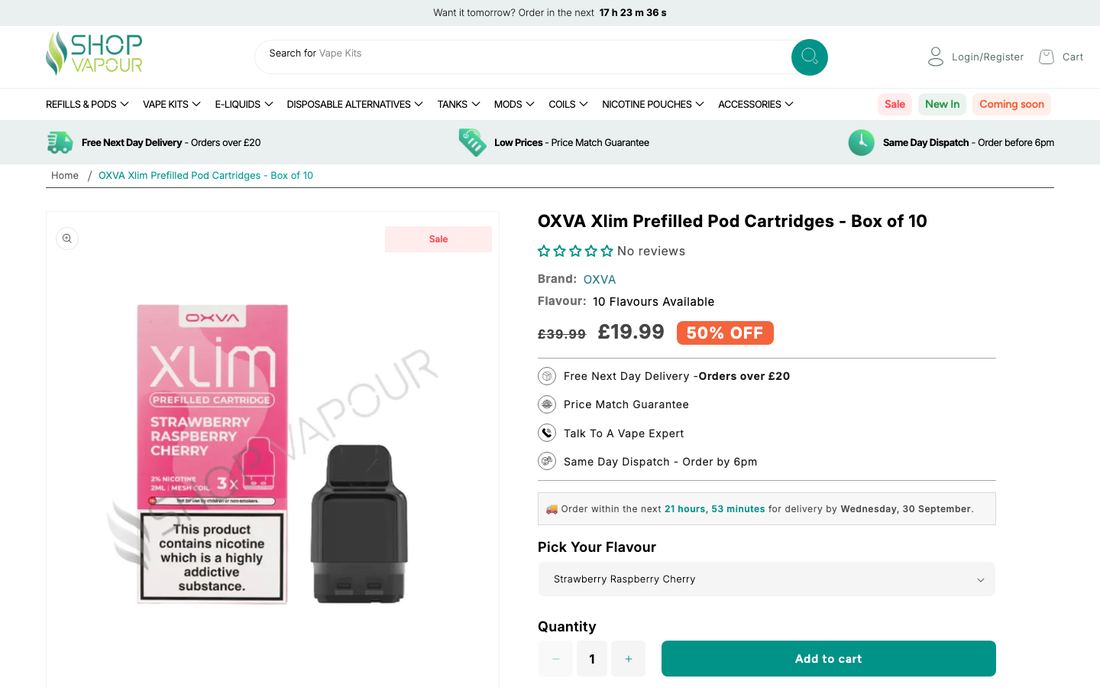 12
12A product page as it stands. The structure gets rebuilt as it is, at this same address.
- Title, reviews, brand and price carried across with the product, at the same address.
- Flavour picker and add-to-cart carried across as they work today.
Your storefront. We rebuild the design you already have: same layout, same branding, same navigation, same product-page structure. We are not going to hand you a new look you didn’t ask for and then explain why conversion dropped. Where something has to change, you see it on staging and approve it before anyone goes live. The target is that a returning customer notices nothing except that pages load faster.
Your page titles and descriptions. Every one carried across as written, not regenerated from a template. Template regeneration is the standard shortcut, and it is why migrated stores come back with thousands of pages sharing three descriptions between them. Good ones survive. Missing ones get flagged, not quietly papered over.
Same addresses, same design, same wording. That leaves very little for a search engine to treat as a new site, which is the point.
§4 The sequence
Ten phases, about six weeks of working time. Plan on eight. That is the honest envelope once approvals and feedback cycles are in it.
| Week | What happens | Done when |
|---|---|---|
| 1 | Phase 0–1. Full address inventory, every data export taken, staging environment built and locked out of search. Payment re-approval applications filed. | Staging live and private; exports archived; applications submitted |
| 2 | Phase 2–3. Address parity configured before any content is imported, then the catalogue import runs | A sample of products resolves at their exact current paths |
| 3 | Phase 4–5. Integrations, shipping, storefront build | Test orders reach fulfilment |
| 4 | Phase 3–6 cont. Reviews, customer records, page titles and descriptions carried over verbatim, fallback redirects loaded | Nothing regenerated from templates; history intact |
| 5 | Phase 7. Full parity test across all 6,927 addresses, checkout tested in sandbox, age verification tested end to end including the rejection path | Parity test passes 100%; payment approvals confirmed |
| 6 | Phase 8–9. Cutover, then daily monitoring | Live, with a 30-day watch running |
The deadline nobody mentions
Payment providers treat vape as high risk. They have to re-underwrite your new site before it can take a single payment, and that runs two to six weeks on its own. There is no way to shorten it and no way to start it after the fact.
That is the real clock. It is why payment applications go in during week 1, before a single product is imported. Ask any agency about it before you sign, because it is the one they will otherwise discover in week 5.
§5 The acceptance test: the part worth keeping
This is the standard we hold ourselves to on the day, written so you can hold anyone to it. Hand this paragraph to any developer.
Every product, category, content and blog address returns HTTP 200 at the identical path, not a 301, not a 404, with a matching self-referencing canonical tag. Every designated fallback redirect resolves in one hop to the correct target. No duplicate-suffix addresses anywhere in the catalogue.
If an agency won’t commit to that in writing, that is your answer. It is binary and testable: the difference between a migration that keeps your traffic and one that explains where it went.
Four more things to make them agree to:
- Payment re-approval filed in week 1. Nothing else matters if checkout can’t open.
- Age verification tested end to end on staging before anything switches over, including the under-age rejection path.
- A password-reset campaign at launch. Customer passwords cannot transfer between platforms, and without one every returning customer is locked out.
- Your current store paused, not closed, for 60–90 days as the rollback.
§6 What it stops costing you
This isn’t the reason to move. But it changes the arithmetic of where you go next, and nobody pitching you a migration seems to mention it.
The line nobody itemises
Vape can't use Shopify's own payment processing. That isn't a choice you made. It is a category exclusion, and it means you are running an external payment provider.
When you do that, Shopify charges you a percentage of every order on top of whatever your payment processor already takes:
2% on Basic · 1% on Grow · 0.6% on Advanced
Take your last twelve months of orders and multiply by whichever rate applies to you. That number grows in exact proportion to how well you do.
On a store you own, that line doesn’t exist. Not reduced. Gone.
The honest other half
A store you own still costs money: hosting, a few licences, and someone to call when something breaks. Better you hear that from us than find out later.
The difference is the kind of cost. It is flat, it doesn’t scale with your revenue, and nobody can change the terms of it in an email with two weeks’ notice.
§7 What we’d need from you
Short list, and none of it is urgent until you decide something. Read access to your search-console data, so we can baseline what you rank for before we touch it. An export of your catalogue and customer records. A list of the integrations you actually use. Your payment provider’s contact, so approval can start on day one.
§8 Where you land
We haven’t named a platform anywhere in this document, and that is deliberate. Every agency in your inbox is recommending the one thing they build, which tells you what they sell rather than what you need.
The right answer depends on things we can’t see from outside: your order volume, who edits the catalogue, whether you want to own the thing outright or rent it again. We work across platforms, and we build fully custom for stores that never want to be at the mercy of a platform policy again. That is a twenty-minute conversation, not a document.
The method doesn’t change either way: 6,927 addresses at identical paths, your design rebuilt as it stands, your titles and descriptions carried over word for word, all of it tested before anyone flips a switch.